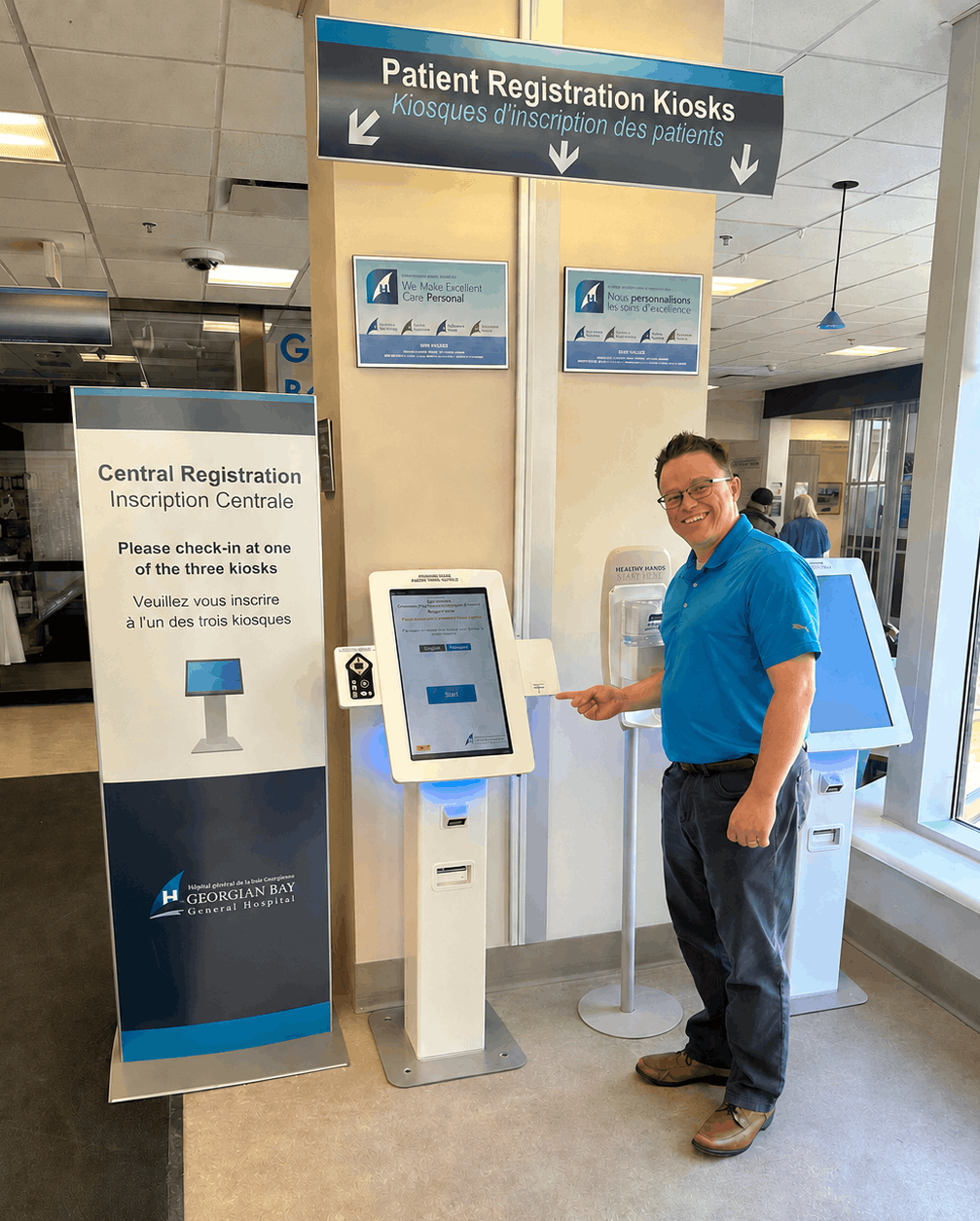
Digital ED Check-in and Patient Calling in Rural Ontario: Lessons from Georgian Bay General Hospital
Rural and community hospitals face a difficult balancing act. They must provide safe, responsive emergency care while working with limited staff, fluctuating demand and smaller local IT teams.
At Georgian Bay General Hospital (GBGH), Savience has implemented a digital ED check-in and patient-calling solution designed around these realities.
Patients can make their arrival known using a self-service kiosk, while clinical and clerical teams can see, manage and call waiting patients through a shared dashboard. The solution does not replace clinical triage or personal support. Instead, it reduces repetitive administrative work, improves data quality and makes the arrival process easier for patients and staff.
The challenge facing GBGH
Before the Savience implementation of ED self check-in and digital patient calling system, patients arriving at the emergency department were registered manually. Patient calling was also manual, with staff using patients’ names in the waiting area.
This was particularly challenging outside normal working hours, when nursing staff could be required to undertake patient pre-registration alongside their clinical responsibilities. Time spent gathering and entering administrative information was time taken away from direct patient care.
Having nursing staff perform pre-registration also increased the possibility of incomplete or inconsistent information entering hospital systems. Improving data quality and protecting the integrity of the hospital’s Master Patient Index (MPI) were therefore important considerations.
GBGH also experiences significant seasonal variation in demand. According to the project team, the population served by the hospital can increase by approximately three times during the summer as visitors and seasonal residents arrive in the region.
The hospital wanted to introduce a more consistent arrival process that would:
- Remove routine patient pre-registration from nursing staff
- Reduce queues at registration
- Make patient arrivals visible to staff
- Improve data quality and protect the integrity of the MPI
- Improve the privacy of patient calling
- Help staff manage patients through the department
- Provide management with better information about demand
Implementation of the digital healthcare soution began in January 2025, with the new system going live in March 2025. Two self-service kiosks and a patient-calling display were deployed in the emergency department.
How the patient journey works with self check-in kiosks and digital patient calling.
The self-check-in kiosk is intended to be the patient’s first point of contact on entering the Emergency Department.
Patients can scan their Ontario health card or enter their health card number manually. The system uses this information to determine whether they can be matched with an existing record in the hospital’s electronic medical record.
The patient is then asked a short series of questions, including questions relating to infection control and their presenting complaint.
This is a controlled pre-registration process. The self-check-in kiosk does not diagnose the patient, determine their treatment or replace clinical triage.
At the end of the process, the patient receives a ticket with a randomized call number and written instructions explaining what to do next. The patient can then wait seated until their number is displayed on the screen in the waiting area.
Depending on the outcome of check-in:
- A patient selecting a designated high-priority complaint can be highlighted to staff.
- A patient who cannot be confidently matched with an existing record can be called to registration.
- A successfully matched patient without a high-priority indicator can be directed to the appropriate waiting area before triage.
Patients who cannot or do not wish to use the kiosk can still receive assistance. Volunteers can help people complete the process, while registration staff remain available for patients with more complicated circumstances.
The purpose of self-service is not to remove human support. It allows that support to be concentrated on the patients who need it most.
Making arrival easier for patients with self-check-in kiosks
An emergency department can be an anxious and unfamiliar environment. Patients may be unwell, distressed or trying to follow instructions while also supporting a family member.
The GBGH check-in process has therefore been kept deliberately simple. Information is presented visually, allowing patients to read and respond at their own pace. They receive written instructions at the end, reducing the need to remember everything they have been told.
For patients and families, the new process provides:
- A clear first step when entering the department
- Confirmation that the patient’s arrival has been recorded
- Less need to stand in a registration queue
- Written information about what happens next
- The ability to wait seated until called
- Greater privacy because numbers are used instead of names
The emergency department self-check-in kiosks are fitted with privacy filters and offer English and French language options. The interface includes accessibility features, including visual display options, and personal assistance remains available.
Using randomized numbers also helps when patients are called according to clinical need rather than strictly in arrival order. This can reduce the perception that someone has “jumped the queue” when there is a legitimate clinical reason for seeing them first.
Making life easier for clinical teams with digital healthcare solutions
One of the most important benefits for GBGH is that nursing staff no longer have to undertake routine patient pre-registration.
The self-check-in kiosks in the emergency department now complete the initial patient identification and pre-registration steps, allowing nurses to concentrate on clinical assessment and patient care. This is particularly valuable outside normal working hours, when fewer clerical resources may be available.
The kiosk supports the process surrounding clinical triage, but responsibility for assessing the patient’s condition, determining urgency and deciding the route into treatment remains entirely with qualified hospital staff.
GBGH can determine which presenting complaints should generate a high-priority indicator. If a patient selects one of these responses, such as chest pain, the indicator is displayed against the patient on the staff dashboard.
The dashboard also gives clinical teams visibility of who has arrived, their status and where they are waiting.
Before implementation, a triage nurse might need to pre-register a patient, leave the triage room, enter the waiting area and call the patient manually. If the patient had moved or did not hear their name, staff could then have to search for them or call repeatedly.
Staff can now initiate a patient call from the dashboard. The patient’s number appears on the waiting-room display and remains visible until staff confirm that the patient has been received. A patient can also be called again if they do not respond.
For clinical teams, this means:
- No routine patient pre-registration for nursing staff
- Fewer non-clinical interruptions
- Less time spent walking into the waiting area
- Less uncertainty about where patients are located
- Better visibility of new arrivals
- Clearer identification of configured high-priority responses
- More time available for patient care
The technology does not make clinical decisions. It removes avoidable administrative work and makes it easier for clinicians to see, locate and manage the people requiring their attention.
Self-chick-in kiosks: Improving data quality and supporting clerical teams
The self-check-in kiosk in the ED provides a consistent and controlled process for initial patient identification.
When a patient scans or enters their Ontario health card details, the Savience matching service queries the hospital’s electronic medical record. Where a complete match is found, key patient information is shown on the Savience Clarity dashboard. Patient identification and arrival details can then flow through an HL7 interface to the MEDITECH ED Tracker, which remains the department’s single source of truth.
Where the system cannot confidently match the patient, it does not assume or create a match. Instead, the patient is directed for clerical support so the issue can be resolved by an appropriately trained member of staff.
This controlled process has improved the quality and consistency of information entering the hospital’s systems. It reduces the risk of incorrect matches, incomplete information and unnecessary duplicate records, helping the MPI retain its integrity.
Some patients will still require clerical help. This can include people who cannot be matched with an existing record, do not have a health card, leave the check-in process before completing it or arrive by ambulance or other emergency transport.
Instead of every patient joining the same registration queue, those requiring assistance can wait in a designated area and be called individually.
This has reduced congestion around the registration desks and allows clerical teams to concentrate on exceptions, data-quality issues and patients needing personal support.
The shared dashboard also shows the patient’s status and location. Clinical and clerical staff are less likely to duplicate work or try to call the same person at the same time.
For registration teams, the benefit is not the removal of their role. It is less repetitive work, better-quality information, fewer crowded queues and more time to resolve the cases requiring their expertise.
Better information for ED management
The system records when the patient completes check-in, giving GBGH more accurate information about arrivals and activity.
Weekly utilization reports help hospital managers identify busy periods and understand patterns in demand. This can support decisions about staffing and the deployment of limited resources.
More accurate arrival information also provides a better basis for calculating and communicating waiting times, helping the hospital set clearer expectations with patients.
For ED management, the solution offers:
- Better visibility of patient arrivals
- A more consistent entry process
- Improved understanding of peak activity
- Better information to support staffing decisions
- Greater control over patient calling and movement
- Less congestion and friction around registration
- Better data quality and greater confidence in the MPI
- More nursing time focused on clinical care
These benefits are particularly valuable in a rural or community hospital, where relatively small changes in staffing or demand can have a considerable operational effect.
A manageable digital solution for hospital IT
Smaller hospital IT teams need technology that does not create a disproportionate local support burden.
At GBGH, the Savience solution integrates with MEDITECH and the ED Tracker using HL7. The system is deployed on-premises, with GBGH IT maintaining the local infrastructure and resolving hardware issues locally. Savience manages and supports the software environment and assisted the hospital throughout implementation, testing and go-live.
An ongoing support agreement covers the hardware and software, with defined service levels and the ability to log an issue at any time.
For GBGH IT, clearly defined responsibilities, Savience software support and an established support agreement help keep the system manageable. As of July 2026, GBGH had reported no system outages since the March 2025 go-live.
Savience also offers a Google Cloud Platform-hosted deployment model. Hospitals choosing this option do not need to purchase, host or maintain local Savience application servers. This can further reduce the infrastructure and maintenance burden, which is particularly valuable for rural hospitals with limited local IT resources.
Cloud hosting can also make it easier to extend the solution to additional hospital sites or other patient-flow services without recreating the complete technical environment at every location.
Results to date: What difference is the self-check-in kiosk making to the emergency department
Figures supplied by the project team in July 2026 indicate that approximately 570 ED check-ins are being completed through the kiosks each week, representing around 69% of eligible patients.
Operational feedback indicates that the implementation has:
- Removed routine patient pre-registration from nursing staff
- Improved the consistency and quality of patient information
- Helped protect the integrity of the hospital’s MPI
- Reduced registration-desk congestion
- Allowed more patients to wait seated
- Improved the privacy of patient calling
- Given staff better visibility of patient status and location
- Reduced the need for clinicians to leave triage areas to call patients
- Improved the accuracy of recorded arrival times
- Provided management with better information about demand
While there is not yet confirmed evidence of a reduction in overall emergency department length of stay, the system shows promising potential to contribute to improvements in this area. Its most clearly demonstrated benefits are improved arrival management, reduced administrative pressure, better data quality, enhanced patient visibility and a more controlled calling process.
Learning from the implementation
One of the strongest lessons from GBGH is the importance of involving the people who will use the system.
Clinical and clerical teams need to understand how the proposed change will help them and should have an opportunity to influence the workflow. The objective must be to solve the problems experienced by the department—not the problems a project team or supplier assumes it has.
The implementation also identified an issue with the original health card scanner. It was not ideally suited to the barcode format used on Ontario health cards, and its position was not as visible or intuitive for patients as expected.
Savience responded by redesigning both the scanner and its housing. The revised design is better suited to Ontario health cards and positions the scanner more clearly for patients, making the check-in process easier and more intuitive.
This is an important part of the implementation story. Rather than simply recording the issue as a lesson for future projects, Savience adapted the physical solution to overcome it.
Other hospitals should also agree in advance:
- How high-priority responses will be escalated
- How matched and unmatched patients will be distinguished
- What happens when someone does not respond to a call
- How patients without health cards will enter the process
- When staff or volunteer assistance should be provided
- Whether an on-premises or cloud-hosted deployment best suits local IT resources
Digital healthcare solutions and technology that supports people who work in healthcare facilities
The GBGH implementation demonstrates that an ED kiosk is more than an alternative to a registration desk.
When introduced as part of a carefully designed workflow, it can make arrival clearer for patients, improve the quality of patient information, protect the integrity of the MPI, reduce repetitive work for clerical teams and remove pre-registration duties and other avoidable interruptions from nursing staff.
It does not replace clinical judgement, triage or human assistance. It makes the surrounding process easier to manage so that hospital staff can devote more of their limited time to the patients who need them.
For rural and community hospitals managing staffing constraints and variable demand, that can make a meaningful difference to the experience of patients and staff alike.
Find out more
Savience works with hospitals in Ontario to improve ED and outpatient check-in, patient calling and patient flow.
To discuss how the approach used at Georgian Bay General Hospital could be adapted for your hospital, contact the Savience team.